
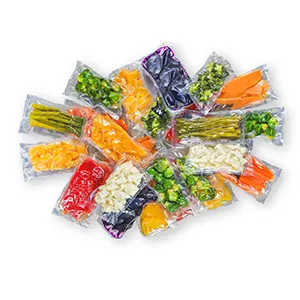
VOLVAC produces solutions for the preparation, processing and packaging of fresh food and salads. The international manufacturers of food processing machinery represented by VOLVAC produce machines for every kind of need. Companies producing fresh vegetables, fruit and salads now have to carry out a number of washing, cleaning, drying and packaging operations before putting their products on the market. VOLVAC provides trouble-free, continuous service and support in these areas.
For perishable ready-to-eat foods, product safety through combinations of minimal processing and storage under controlled heating/cooling conditions forms the critical points of the technology for preventing the growth of pathogenic organisms and ensuring microbial safety. With pre-preparation, slicing and chopping, multi-stage washing, insect separation, alternative drying, root vegetable peeling and dicing for leafy and root products, our packaging solutions meet the needs of both small-scale and industrial production.
The washing water should contain a certain amount of chlorine to reduce the microbial load. Washing systems should be single-stage, or two-stage if the produce comes straight from the field and contains mud. Each unit performs turbulent washing with two pumps, and the produce is then rinsed under a shower and washed with cold water. The water is filtered and reused. A certain amount is allowed to overflow to prevent contamination. After washing, the products are dried by centrifuge. The product must be completely dry before packaging. Water droplets on the product would cause it to spoil faster and shorten its shelf life. In addition, salad ingredients must be dried after washing so that the salad mixes well with the dressing.
Minimally processed foods can be produced using a range of modern technologies that aim to minimise loss of nutritional value and change from production to consumer as little as possible, while providing sufficient shelf life until the product reaches the consumer. To prevent the growth of pathogenic organisms in foods and ensure microbial safety, safe food production is achieved through combinations of minimal processing, portion packaging, heat treatment and storage under controlled cooling conditions.
HACCP, which can also be described as identifying every point that may pose a risk from production to consumption separately for each product, examining and controlling these points and eliminating problems, means determining "critical control points (CCP)", reducing risk and thus preventing hazards. First introduced for space programmes, this concept was later adapted to industry in the USA, gradually spread to Europe, came into use among community members and has become mandatory for some sectors.
The principle of this system is to identify, from the outset, preventive measures against hazards that could arise from delays due to end-product inspection or from irreversible failures.